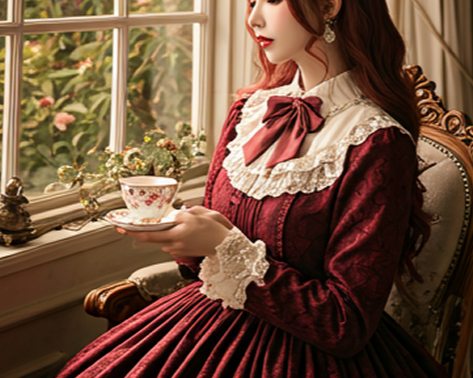
Understanding lace: from chantilly to guipure
Understanding lace: from chantilly to guipure Exploring the delicate details that bring romance and artistry to fashion. Lace has long held a special place in the world of fashion. Delicate yet intricate, ornamental yet functional, it has the remarkable ability to transform a simple garment into something extraordinary. Within Lolita fashion especially, lace is more than a decorative afterthought—it is an essential element that contributes to a garment’s personality, elegance, and charm. Whether trimming the cuffs of a blouse, framing a collar, or cascading down the hem of a dress, lace adds texture and depth that few embellishments can rival. Yet despite its prominence, many people are unfamiliar with the differences between the various types of lace used in dressmaking. Understanding these distinctions not only deepens our appreciation for craftsmanship but also helps us make informed choices when investing in garments and sewing projects. A brief history of lace Lace first gained widespread popularity in Europe during the sixteenth century, where it quickly became associated with wealth and status. Handmade lace required countless hours of meticulous labor, often produced by highly skilled artisans whose techniques were closely guarded. Royal courts embraced elaborate lace collars, cuffs, and veils as symbols of refinement and prestige. Over time, advances in textile production made lace more accessible, allowing it to transition from a luxury reserved for the aristocracy to a beloved decorative element across many styles of dress. Today, lace exists in countless forms, ranging from traditional handcrafted varieties to machine-made interpretations inspired by centuries-old techniques. Chantilly lace : delicate elegance Perhaps one of the most recognizable lace varieties, Chantilly lace is celebrated for its ethereal beauty. Originating in eighteenth-century France, this lace is typically characterized by: Fine net backgrounds, Intricate floral motifs, Delicate detailing, Soft drape, Outlined patterns created with thicker threads. Chantilly lace often evokes a sense of romance and sophistication. Its lightweight appearance makes it particularly suitable for overlays, sleeves, veils, and elegant accents. Within Lolita fashion, Chantilly lace frequently appears in Classic and Gothic styles, where its graceful motifs complement refined silhouettes and vintage-inspired aesthetics. Guipure lace: bold and structured Unlike Chantilly lace, Guipure lace has no visible net background connecting its motifs. Instead, decorative elements are joined by bars or plaits, creating a more sculptural appearance. The resulting effect is striking and substantial. Guipure lace is often recognized by its: Distinct raised motifs, Heavier structure, Dramatic visual impact, Durability, Dimensional texture. Because of its bold presence, Guipure lace is commonly used as a statement feature. It may adorn necklines, sleeves, bodices, or decorative panels that benefit from additional texture and emphasis. Its structured beauty makes it equally appealing in both contemporary fashion and historical-inspired designs. Cotton lace: a timeless favorite For many enthusiasts of Lolita fashion, cotton lace remains the gold standard. Soft and breathable, cotton lace possesses a charming authenticity that pairs beautifully with natural fabrics. It often features simpler motifs that evoke vintage garments and heirloom craftsmanship. Cotton lace is especially popular because it: